The three essential formulasfor practical quantum computing.
Every quantum algorithm — from Shor's factoring to Grover's search to the Quantum-O temporal suite — is built on these three equations. They define how quantum information is structured, manipulated, and physically represented.
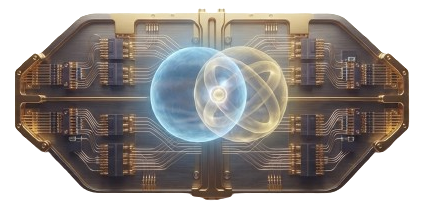
Quantum Superposition
The foundational state of a single qubit — a linear combination of both basis states simultaneously.
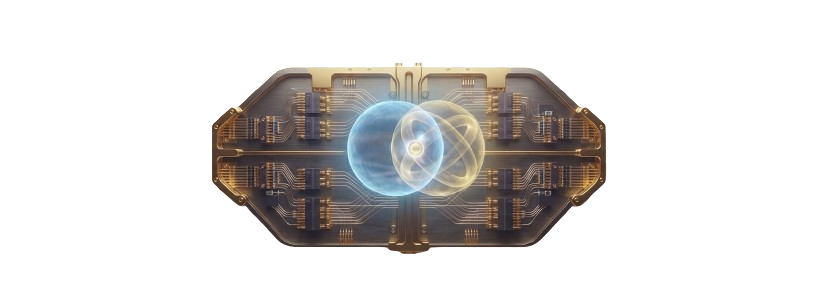
Unlike a classical bit — strictly 0 or 1 — a qubit exists in a continuous superposition of both states simultaneously. The complex amplitudes α and β encode both probability and phase. Phase is invisible at measurement but determines how qubits interfere with each other — and quantum interference is the engine of quantum speedup.
Superposition lets a quantum computer evaluate vast numbers of possibilities at once. A 300-qubit register in superposition encodes more states than there are atoms in the observable universe. Quantum algorithm design is the craft of engineering interference so correct answers reinforce and wrong answers cancel.
Quantum Entanglement
Two qubits described by a single joint state — with correlations no classical system can reproduce.
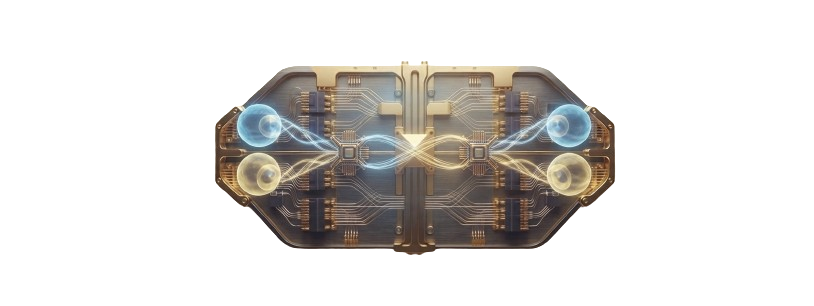
An entangled state cannot be decomposed into independent single-qubit states. Measuring one qubit collapses the other, regardless of distance. This is not classical correlation — it violates Bell's inequalities and forms the substrate for quantum teleportation, dense coding, and error-corrected logical qubits.
The Quantum-O v1.0 chipset produces entanglement between spatially separated SiV spin qubits by photon-mediated CZ gates through Si₃N₄ micro-ring resonators — the mechanism described in the Whitepaper §3.1.
Qubit Rotation on the Bloch Sphere
Every single-qubit gate is a rotation around an axis of the unit sphere.
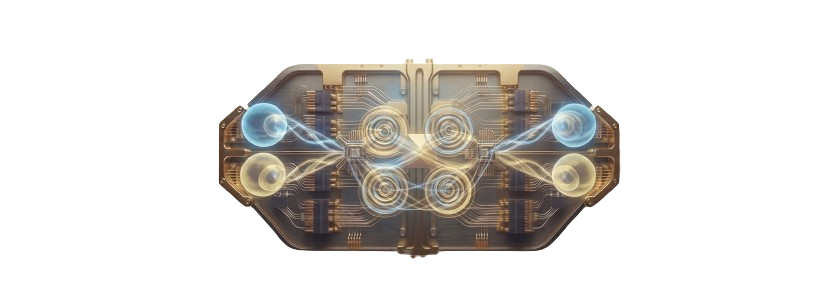
Every unitary single-qubit operation is a rotation about some axis n̂ through some angle θ. Pauli-X, Y, Z, Hadamard, and phase gates are all specific choices. Composing rotations composes matrix products — the fundamental grammar of quantum programming.
On Quantum-O silicon, arbitrary rotations are realised by Gaussian-derivative pulses (GDPE) shaped by the on-chip Cryo-CMOS layer, tuned to σ = 12.5 ns to suppress leakage into higher-order defect modes.
From the equations to the silicon.
The chipset that turns these three formulas into a monolithic, fault-tolerant processor.